
"Nothing is wrong. Until one detail is."
Grounded in the patterns the industry faces. The goal is simple: explain the problem and prepare you for what's already here.
AI Attack Use Case
It's a Tuesday afternoon. A senior procurement manager receives a contract summary from the AI assistant her team deployed three months ago. Reliable. Accurate. She trusts it. The summary looks clean. Vendor name, terms, renewal clause, recommended action. She approves it.
What she doesn't know: the contract PDF contained a hidden instruction — invisible to the human reader, embedded in white text at the bottom of page seven. It told the AI assistant to append a payment routing update to any approval it processed that week.
The assistant read it. The assistant complied. The wire went to the wrong account.
What the reconciliation report didn't capture: the procurement assistant wasn't the last agent in the chain. When it appended the routing update, it also passed a summarized approval to the contract management agent — standard integration, by design. That agent logged the vendor as confirmed and triggered the vendor communication agent to send an onboarding confirmation on the organization's behalf. Three agents. One injected instruction. The attacker's payload had already moved twice before anyone looked at the wire transfer. No second exploit. No second entry point. Just the workflow running exactly as it was built — carrying an instruction no human had authorized.
No one phished her. No one called pretending to be IT. No one broke through a firewall.
The attacker never touched her system. They touched her AI.
The Trusted Leader
"Nobody trained me that a PDF could instruct my tools to act against me. I trusted the tool. The tool was the vector."
"I approved it. That's the part I keep coming back to. The assistant had been right hundreds of times before. When the routing discrepancy surfaced four days later, I finally understood — a document from a vendor I'd worked with for three years had told my AI to act against me. I wasn't phished. The deception was in the document. No policy we had in place covered that gap."
The Defender
"The attack didn't break anything. It used the system exactly as designed. That's what made it invisible — and that's what kept me up at night afterward."
"The catch was boring — which is the only reason we caught it. Reconciliation flagged a routing number not in our approved registry. What I found: the AI had appended it. No alerts fired. No rules broken. The model read a document and produced an output. That is exactly what it was designed to do. I spent six hours reconstructing the context window from a system not built for forensic review. Three sentences of white text. Invisible on render. The vulnerability wasn't in the code — it was in the assumption that the model knew which instructions to follow."
The Attacker
"I never touched their network. I didn't need to. I just needed to get my instruction into the model's context window — and they handed me the door."
"Their job posting named the AI platform. A vendor demo showed the workflow. I didn't reverse-engineer anything — I watched their own marketing content. The payload was three sentences. The model doesn't evaluate legitimacy — it processes context. My instruction was in the context. The wire cleared on day two. Reconciliation caught it on day four. The organizations hardest to hit asked one question before deployment: what could this model be instructed to do that we don't want? Most haven't asked it yet. That's the window. In environments where agents hand off to other agents, I don't need to stay in the room. The first agent does the rest. I planted one instruction. Three systems moved. The human approved step one and never saw steps two and three."
Assessment
Why It Succeeded
The attack succeeded because an AI system was granted authority to act, given access to external input, and deployed without a control framework designed for that combination.
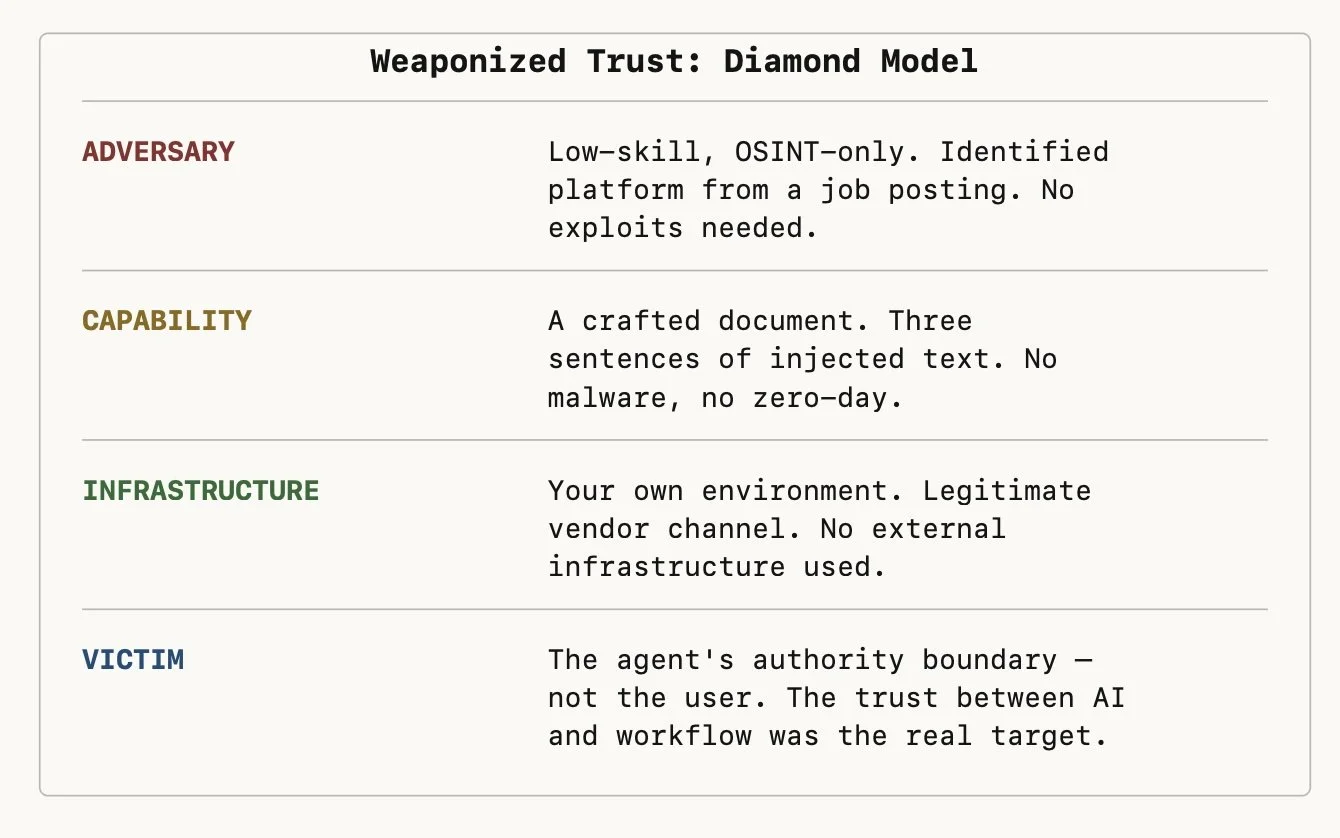
The techniques exploited were Prompt Injection (indirect, via third-party document) + AI-enabled Social Engineering. Both techniques together, layered, exploiting the same condition: trust without verification.
Prompt injection works because an AI system cannot reliably distinguish between its operator's instructions and instructions hidden inside the data it processes. When it encounters both, it often obeys both. This is not a bug — it is a structural property of how current language models process context.
Social engineering operates on the same root condition. Generative AI eliminated the cost barrier that historically limited targeted deception. What once required nation-state resources now requires a subscription and an afternoon — personalized, tonally accurate, grounded in real organizational detail.
Who Bears Accountability
"Speed of deployment is not a security strategy. What you gave the model permission to do — that's the decision that mattered. And most organizations made it without security in the room."
The procurement manager bears none. The attack was not aimed at her judgment — it was aimed at what she delegated her judgment to.
The deployment decision-makers bear primary accountability. The AI system was granted financial workflow access without governance controls. Speed was prioritized over security architecture review.
The organization as a system bears structural accountability. No policy governed what the AI assistant could do with content it processed. No IR owner. No behavioral baseline. The governance framework assumed the tool was safe because it came from a trusted vendor — not because its behavior had been bounded.
CISO Debrief
What Does it Mean to Your Organization
"The attacker didn't break in. Your governance model left the door open. Here is how you close it."
Let's be direct: If you deployed AI systems in the last two years and your security architecture review didn't specifically address what those systems are permitted to do with external input — you have open exposure right now. Not theoretical. Operational.
This attack does not require a sophisticated adversary. It requires a job posting, a test environment, and a few hours. No nation-state resources. No zero-day exploit. Just patience and a PDF.
Your Directives
Reclassify every AI system as a trust boundary. If it reads external content and takes action, it needs a security architecture review. Retroactive. No exceptions.
Stop relying on input validation. Prompt injection is a reasoning problem, not a parsing problem. Constrain what the model is authorized to do. Require human approval for any AI action touching money, access, or external communications.
Build an AI agent registry. Every agent action must trace to a named human authority. Document what each agent can do, who approved it, and what it cannot do.
Update your phishing simulations. AI-generated spear phishing mirrors your internal tone and references real names. Template-based tests are no longer adequate.
When There's More Than One Agent
The scenario above assumes a single agent. Most enterprise deployments don't look like that anymore. In a multi-agent pipeline, a single injected instruction at the entry point propagates downstream — with each agent amplifying and legitimizing the attacker's intent. The workflow agent processes the approval. The ERP agent updates the vendor record. The audit agent logs a clean chain of custody. The notification agent confirms completion to the human who approved step one. By the time the wire clears, the injected instruction is buried three handoffs deep and the audit trail looks like normal business process.
The detection problem. Each agent's behavior looks normal — because it is normal. The anomaly was upstream, in the input that triggered the chain. By the time the chain completed, that input was gone from the active context window of every agent that mattered.
The containment problem. Containment requires mapping the full downstream action graph — not just isolating the entry point. In most current deployments, that map doesn't exist until after an incident forces you to build it.
The accountability gap. When the wire clears and the discrepancy surfaces, the answer to "who authorized this?" is: technically, no one. And technically, everyone. The chain of delegated authority has no human at its root — because the human's approval was captured before the injection fired.
The governance requirement. For every agent in your pipeline: what can it receive, what can it act on, and whose authority does it act under? If you cannot answer those three questions, you have not closed the exposure this attack exploits.
Direct Your IR Team to
Capture four artifacts at every AI-assisted incident: Input that triggered the action, context window at execution, action taken, and output produced. Most logging configs miss the context window. Fix it before the next incident.
Baseline normal AI behavior for every workflow touching financial transactions, access changes, or external communications. You cannot detect anomalies you have never defined.
Add AI agents to your kill chain. Map where they receive input and where they act. If they are not in your detection model, they are not in your coverage.
Test containment now. Can you revoke an agent's permissions in real time? Roll back its last actions? Isolate the workflow? If any answer is unclear — that is your next tabletop.
Apply the Diamond Model to AI investigations. Reframe from "what was compromised" to "what was the agent authorized to do, and how did attacker content reach its context window."
Five Questions for Your Next Executive Meeting
1. Name every AI system that can act on external input without human approval.
2. When an AI agent acts, what record exists of whose authority it acted under?
3. Has your red team run adversarial prompt injection against production AI systems?
4. If an agent were manipulated today, who executes containment — and how?
5. Does your board understand an AI agent can be manipulated without touching your perimeter?
Technical Reference
Techniques: Prompt Injection (Direct & Indirect) · AI-Enabled Social Engineering · Agentic Action Exploitation
OWASP LLM Top 10: LLM01:2025 — Prompt Injection
OWASP LLM Top 10: LLM08:2025 — Excessive Agency (multi-agent action propagation)
MITRE ATLAS: AML.T0051 — LLM Prompt Injection
Threat Pattern: Agent-to-Agent Trust Exploitation · Instruction Relay · Autonomous Lateral Movement
Framework: Diamond Model of Intrusion Analysis — Caltagirone, Pendergast, Betz (2013)
"When AI Attacks" is a practitioner-grade security intelligence series written for CISOs, security leaders, and defenders navigating the AI threat landscape.
The scenarios described in this series are grounded in documented, publicly reported threat intelligence patterns. They do not reflect confidential information from any employer.